



UV flatbed printer is a digital printing device that achieves instant drying through ultraviolet light curing technology,Suitable for various irregular material surfaces.The core advantage lies in the fact that it requires no plate making and dries instantly after printing,It is compatible with both rigid and flexible materials.It is widely used in personalized customization and industrial production.
This article takes a device with high-drop printing capability as an example.Analyze its technical principles and practical application scenarios.
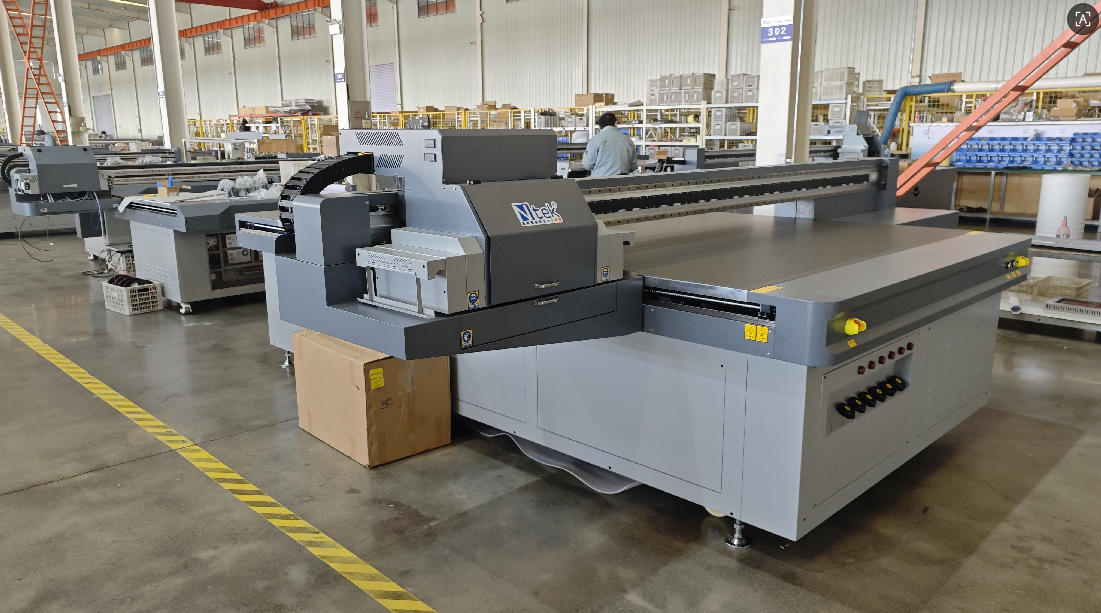
I. Technical Principles and Core Components
Inkjet Technology: These printers use piezoelectric inkjet technology, which allows precise control over ink droplets by deforming a piezoelectric crystal under voltage. The printhead adjusts the droplet size and position, ensuring a high level of precision.
Resolution and Nozzles: The printer can adjust resolution from 360×600 dpi to 1200 dpi, supporting 4-16 nozzles working in combination for a single print width of up to 2500mm.
UV-curable Inks: The system uses three types of UV inks (LH-100, LUS-120, LUS-150), covering C/M/Y/K and extended colors. The ink cures almost instantly within 0.5 seconds under UV light, preventing smudging or ink seepage.
II. High-Drop Printing Implementation
Uneven Surfaces: For surfaces with unevenness up to 15mm (e.g., phone cases, leather), the printer uses an intelligent lifting platform and dynamic nozzle adjustment technology. This ensures the distance between the nozzle and material is adjusted dynamically throughout the printing process.
Precision Control: This allows for a vertical droplet landing error of less than 0.1mm, enabling direct printing even on smooth surfaces like glass or acrylic without needing a coating.
III. Application Scenarios and Material Compatibility
UV flatbed printers can handle a wide range of materials, including:
Rigid boards: Wood, acrylic, glass.
Flexible materials: Leather, PVC.
3C product accessories: Phone and tablet cases.
Decorative materials: Tiles, metal sheets.
Irregular objects: Spherical or curved surfaces.
The UV inks used have high scratch and wash resistance, and the print can cover 92% of the NTSC color gamut with 8-color gradient effects. This makes them suitable for commercial displays and industrial signage.
IV. Operating Procedures and Safety Precautions
The equipment needs to operate in an environment with a constant temperature of 20-30℃ and humidity of 40-60%,To prevent ink viscosity changes due to temperature fluctuations.Before operation, check the condition of the nozzle,The self-test procedure confirmed that there was no ink interruption.Do not touch the uncured ink surface during printing,Prevent direct sunlight on the skin.The nozzles must be cleaned with a special cleaning solution during maintenance,Replace the filter regularly to ensure unobstructed ink flow,After the equipment is shut down, the main power supply should be turned off and the dust cover should be placed over it.